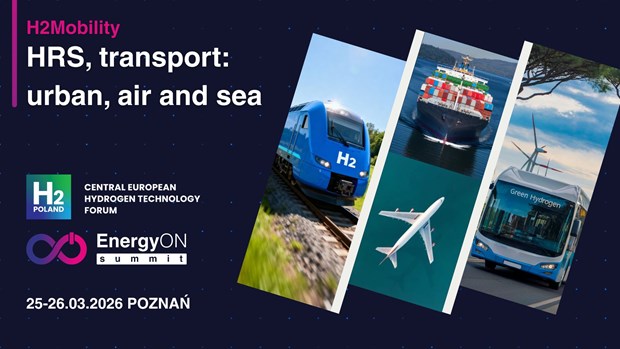
HRS, transport: urban, air and sea
Hydrogen mobility is currently developing simultaneously at the municipal and regional levels — and key decisions by local governments regarding the construction of H₂ stations affect the entire zero-emission transport ecosystem. During H2POLAND and EnergyON Summit, we will show how to create effective business models for urban fleets and how to integrate local investments into the broader AFIR and TEN-T infrastructure, supporting heavy and inter-agglomeration transport.
Panel 1: From jet fuel to hydrogen: the real cost of decarbonizing aviation
Aviation today faces one of the most difficult transformation tasks in the entire economy: reducing emissions while maintaining competitiveness, route profitability, and growing scale of operations. It is a global sector operating on very low margins, where any cost change immediately translates into ticket prices, route availability, and competitive position vis-à-vis less regulated markets.
However, it is crucial to look at aviation not only through the prism of the carrier. The transformation affects the entire aviation operations chain:
- aircraft manufacturing and the development of new engines,
- fuel and energy producers,
- airports and infrastructure operators,
- ground operations, maintenance, and logistics,
- air traffic management systems.
Today, an airport is not just a transport hub – it is becoming an active participant in the energy transition. This means investments in renewable energy sources, energy storage, electrification or hydrogenization of ground operations, modernization of fuel infrastructure, waste management, energy efficiency of terminals, and new safety standards. The decarbonization of aviation is therefore a transformation of the entire operating ecosystem – not just a change of fuel in the tank.
The panel aims to “debunk” the narrative of a quick and easy transition from fossil fuels to alternative fuels – by honestly estimating the real cost of decarbonization across the entire value chain: from energy generation, through fuel production, to technology implementation and infrastructure modernization.
The discussion will compare three main transition paths:
- SAF (Sustainable Aviation Fuels) as a bridging solution, compatible with the current fleet, but limited by the availability of raw materials and high costs,
- e-fuels (e-kerosene/e-SAF) as a potential target for long-haul flights, requiring huge amounts of green energy and hydrogen,
- hydrogen – both in turbine combustion and fuel cells – as a potential game-changer for short- and medium-haul flights.
In this context, a fundamental question arises: is aviation really on the verge of a technological breakthrough? The concepts of hydrogen-powered aircraft developed by Airbus, among others, as part of the ZEROe program, show a vision of a new propulsion architecture and airframe design. At the same time, hybrid-electric propulsion systems and new aerodynamic configurations adapted to the different energy density of the fuel are being developed. However, the implementation of such technologies means not only a change in aircraft design, but also a profound transformation of airport infrastructure, safety systems, and fuel logistics.
The panelists will answer the question: what does the “cost” of decarbonization mean in practice - not only in PLN/MWh or €/tCO₂, but also in:
- capital expenditures (CAPEX) and operating costs (OPEX),
- regulatory risks and volatility of public policies,
- availability of energy, hydrogen, and raw materials,
- infrastructure and logistical constraints,
- impact on weight, range, and operational capacity,
- effects on passengers (ticket price, frequency of connections, accessibility of regions).
Particular emphasis will be placed on hidden systemic costs that are often overlooked in the debate: the need to expand renewable energy sources and power grids, energy and water for the production of hydrogen and e-fuels, the costs of adapting airports for liquid hydrogen storage, new safety requirements, and the risk of “greenwashing” resulting from life cycle assessment (LCA) methodologies.
The panel will also show how quickly realities are changing through public policies and support mechanisms: SAF mandates, certification systems and sustainability criteria, contracts for difference, tax breaks, and investment financing instruments.
The result of the discussion will be a concrete roadmap for the entire sector – from carriers and fuel producers to airports and aircraft manufacturers:
- which technologies make sense here and now,
- in which market segments (regional, cargo, long-haul),
- what are the boundary conditions for profitability,
- where are the biggest bottlenecks (energy, infrastructure, regulations, supply chain),
- what are the realistic expectations of individual market participants.
The outcome of the discussion will be a concrete decision map: which technologies make sense here and now, in which market segments (regional, cargo, long-haul), what are the boundary conditions for profitability, and where are the biggest bottlenecks (energy, infrastructure, regulations, supply chain). The panel will also help the audience understand why decarbonizing aviation is costly—and what can be done to reduce this cost, rather than simply passing it on.
Panel 3: Mobility as part of the energy system – hydrogen, energy storage, and new security architecture
The current energy transition is redefining the role of transport. Mobility is no longer just a consumer of energy – it is becoming an active participant, a storage facility, a system stabilizer, and part of the country's critical infrastructure. The development of electromobility, hydrogen technologies, and large-scale energy storage systems (BESS) means that strategic transport hubs – seaports, airports, logistics centers, and railway hubs – can serve as local energy hubs, integrating renewable energy sources, the power system, and the balancing market.
The panel will focus on analyzing the role of hydrogen as an energy carrier enabling seasonal storage and decarbonization of heavy, maritime, and air transport, as well as on the synergy between H₂ and BESS installations in the context of system flexibility. The discussion will also cover energy security architecture issues, including the resilience of transport infrastructure to fuel crises, blackouts, and geopolitical threats.
Particular attention will be paid to the integration of H₂ + BESS hubs with renewable energy sources (offshore, PV, onshore), their participation in the capacity market and system services (FCR, aFRR, mFRR), as well as regulatory models enabling the development of the sector. Experts will attempt to answer the question of whether mobility will become one of the key sources of flexibility and stability for the national power system in the next decade.